Friday, November 18, 2011

SLE - Week 4


On day one of Lighting Concepts and Design, our lecture instructor said point-blank, “ Let’s be honest; you guys just want to make the lights wiggle.  But you have to know the basics before you can get to that point.”  This is absolutely correct which is why we were introduced to lighting with conventionals rather than automated lights.  You have to learn to crawl before you can walk.  I feel that this same approach is often over looked, though, even when you get to an advanced level of lighting design and system building.

My background, and passion, is in the theatre – it’s how I got started in this industry.  One of the most annoying things that I’ve faced in a permanently installed building, though, is nothing on my rig, but something still under my control: house lights.  Even when it comes to a lot of corporate events that take place in conference rooms, and small tours that hop to smaller venues, very seldom is direct, dimmable control of the house lights achievable.

Enter: LDI2011’s Best Green Product, the ArcSystem House Light.  First off, it’s “green” because it’s all LED – 25W per cell, in fact.  The units are available as sleek, single-cell recessed lights, to 2, 3, 5, and 8-celled fixtures.  The 8-cell is capable of outputting up to 9,600 lumens, and all of the units offer smooth electronic dimming and can produce 2700 K, 3000 K, and 4100 K color temperatures.  The fixtures use a low-glare reflector system to create a soft beam pattern and can produce beam angles of 19º, 24º, and 37º.

Lastly, and most importantly, since these lights are LED’s and have lower heat output to begin with, the entire fixture is cooled by convection only.  No fans means a quieter house and will allow your guests to actually hear your walk-in music rather than the ceaseless drone of fans.

The interesting thing about the ArcSystem House Light, though, is its means of control.  The fixtures use the Arc Mesh Control Protocol instead of plain DMX.  In conjunction with an ArcNode, this allows the fixtures to be controlled via either DMX, ArtNet, or other Network control; monitor faults and temperatures; set patching, power fail auto recovery options, minimum light levels, and preset recalls.  The fixtures even offer convenient webserver configuration.

Friday, November 11, 2011

SLE - Week 3


Whether they are Strand or ETC, we generally just call them “lekos”.  I personally was introduced into the lighting business with a plethora of Strand fixtures which were exact matches to the Source 4 series except for the fact that the Strand ERS’ could actually rotate inside the yoke collar; which was perfect for orienting gobos instead of having to burn yourself to adjust it inside the gobo frame. And thus I digress.

So we all know the two most popular brands of the typical ERS, but there was always one company that was always trying to be like everyone else: Altman.  They started off with the 360Q but it was heavy, clunky, and didn’t meet up to the expectations as the other ellipsoidals on the market.  So they made some improvements and introduced the 3.5Q.  Closer, but still not quite the same.

And now finally, years much later than it should have been, Altman has introduced its latest series; the “Phoenix”.   It’s pretty much all that you would expect to see from any ellipsoidal spotlight.  And really, the fixture even looks the same as Strand’s.

So while I’m a little dumbfounded as to why Altman would waste their time seemingly just trying to copy the competition, I will give them some, albeit very small, props as to their choice of lamp.  They did stick to the good ol’ conventional pattern and made the Phoenix compatible with both GLA and HPL lamps in 375w, 575w, and 750w choices.  Not to turn around and bash the props I just gave, but I still can’t understand why they didn’t directly compete with the LED ERS race that is currently going on.  But that’s just my own perspective.

Like I mentioned earlier about my favorite Strand feature, the Phoenix takes the form more from a Source 4 and allows just the barrel to rotate a full 360 degrees for gobo alignment instead of the entire luminere.  The lenses are also standard with the choices of  5º, 10º, 19º, 26º, 36º, and 50º.

Oh and one more thing, what would an Altman fixture be without it’s DUAL LOCKING HANDLES?


Sunday, November 6, 2011

SLE - Week 2


This week’s blog post is a highlight of a sneak peak review of the newly released Best Boy 4000 Spotlight by PRG.  While browsing Live Design Online, my eye was caught by quite the unusual looking intelligent fixture in the articles summary blurb.  But of course, with a name like “Best Boy”, you can’t help but read a bit more.

So why should anyone turn their head to this new fixture?  Well there are several reasons why this new toy deserves the high reviews but first and foremost, this is one of the first fixtures on the market to take full advantage of the new servomotor technology and implement them in every mechanism.  The trending theme of this fixture of “smooth, fast, and quiet” starts with its motors and their ability to move the fixture smoothly without the jitter like that of micro stepping motors, and quickly without becoming obscenely loud.

But what is a light without a lamp? Exactly, so the next impressive thing on the list is the lamp and optic train.  Best Boy uses an MSR-700 short arc lamp but it is electronically overdriven to 800 watts which provides 21,000 lumens of output.  Even with all the motors active at full speed simultaneously, the fixture only pulls 5 amperes at 208 volts.  The auto-sensing power supply can accept input voltages anywhere from 90 to 264 volts.

The optics system, driven by servomotors, provides an 8:1 zoom/focus track allowing the beam angle to range from 8º to 64º which is exceptionally versatile.  The typical hotspot formed by all fixtures, though, is not something that is produced by Best Boy; the pool of light is completely even field.  By default, a tracking auto-focus feature is enabled which will keep gobos in focus and will transition quickly and smoothly.

Speaking of gobos, Best Boy has two wheels of 6 gobos each, all rotatable, and include two “moiré” effects – a kaleidoscopic and animation type of effect.  In a third wheel, several choice of multiplying and faceted prisms are offered.  The two gobo wheels have enough space between them to offer the ability to focus shift between the patterns.

Finally, color.  Best Boy offers CMY color mixing, driven by (again) servomotors which can snap between colors at opposite ends of the spectrum as fast as adjacent dichroics in a color wheel – which Best Boy has a dichroic wheel too.  The most fascinating thing, though, is the dimmer and color temperature correction wheels.  Both of these are dichroic gradients to offer smooth and continuous shifts which makes a very even dimmer curve and offers many options in color temperature.  More impressive, though, is yet another wheel which offers a minus-green gradient so you can mock the apparent lamp age of other fixtures in the rig.  This is especially handy when using the Best Boy in a rig full of conventionals as the CT wheel offers matching to a Source 4.

I must admit that I am a bit sad that I missed this great product from PRG at LDI last week.  I hope for an opportunity to become personally acquainted with such an amazing and useful fixture.  This really is something you have to see to believe.  Why not check out a video of Best Boy in action?


Sunday, October 30, 2011

SLE - Week 1


First off, I have to be honest: LDI was my first technology tradeshow.  I’m quite familiar with how these conventions work, though, as I’ve been to the Detroit International Auto Show for the past five years.  But let me be clear; LDI was the most impressive thing I have ever witnessed, hands down.

I think the most obviously captivating booth at the show was LaserNet, considering you could see their demonstration from anywhere in the hall, and the most impressive was the most talked about Chauvet exhibit.  I don’t believe I have ever seen more lights crammed per square foot in my life.

But enough about superficial aesthetics.  There were only three products that I was truly impressed with.  Clay Paky caught my eye first with their unique rotating truss.  But it was what was on the truss that I was blown away by: The Sharpy Moving Light.  It is the quickest moving yoke fixture with a 190 W discharge lamp that outputs a zero degree beam of light.  While it may not be of any use for lighting a subject, it definitely has it’s uses for moving effects on large rigs.  With such a narrow beam and rich color mixing, I would even use them for truss warmers.

Second in lighting was the GLP Impression Spot One – a moving yoke fixture containing only LED’s with a comparable light output of a 575W incandescent.  Complete with 2 rotatable gobo wheels, an animation wheel, RGB color mixing, focus, iris, and prism, I was truly impressed by the bright and crystal clear output of the fixture.  The halo-free and completely smooth pool of light made a very defined hard edge that could be nicely faded by using the focus parameter.  It also boasted very nice flicker-free electronic dimming and super quick electronic strobing.

Lastly, I was nearly completely sold after being introduced (for a whole hour) to the Compulite Vector series. The models on display where the violet (smallest) and red (largest) but several mid-sizes are offered as well.  The sleek and attractive work surface is complete with two (or three for the red) touch screens to make navigation and operation a breeze.  The intuitive software allows for quick and easy programming and flexible operation to move any function to any control on the surface.  Even the master AB faders can be moved to any one of the executable faders of your choice.  With the exception of the budget consoles (the violet and ultraviolet), the surface offers either 10 or 20 motorized playback faders which allow you to page through up to 200 fader playbacks and 200 executer-only playbacks.  All their consoles run Windows XP and can output 8 DMX universes either locally or over artNet.

I must conclude by also sharing that I had a wonderful time being part of the Full Sail exhibit and being able to share with other industry professionals about my time at the school and answer their questions about what we do.

Thursday, October 20, 2011

SPS - Week 4


This week’s blog post comes from an article from DPAmicrophones talking about the process and specifications of measuring microphones.  Although the concept is fairly simple to go about taking measurements from a microphone, there are some discrepancies in how the measurements are taken, the accuracy of the data, and even how the measurements are listed according to the manufacturer.  

When charting a frequency response graph, manufacturers can actually use two methods to show better performance from their microphones than what a given actual product may be able to replicate.  Deception may evolve from two places: in measurement and in data representation.  There are two methods by which measurements can be taken: point-by-point and continuous sweep.  The point-by-point method measures a pure sine wave at several select frequencies and a graph is formed by the collected points.  Unless 20,000 measurements are taken, the accuracy of the chart is less than perfect, but peaks and valleys of the response are more detailed as opposed to the continuous sweep.  When measuring using a continuous sweep method, a sweeping sinusoidal wave through the audible spectrum is captured by the microphone.  The output is analyzed against the input and the resulting graph is printed in real time.  This method may seem more accurate, however it is required that a manufacturer lists the speed at which this method was performed on the resulting graph.  If the sweep moves too quickly, it is highly likely that a flatter response will be recorded since the diaphragm of the microphone does not have time to fully capture individual frequencies.  Deception may also come by the frequency response graph itself as manufacturers may show the actual measured frequency response, or a “typical” (averaged) response with a tolerance field (quality control).

The measurement standard for a microphone involves four things: The accuracy of the measurement equipment, the calibration of the measurement equipment, the laboratory’s acoustical environment, and the quality and calibration of the reference microphone.  However, finding a standard form of referencing measurements of different microphones has definitely been one major problem.  Different areas of the world adhere to different sets of rules and regulations set forth by their specific standards committee; the top three being the International Electrotechnical Commission (IEC), the Deutsche Industri Norm (German DIN), and the Audio Engineering Society (AES).  Right here from the get-go we can see a possible area for measurement discrepancy.  Some of the larger named microphone manufacturer’s are German and might be more likely to adhere to the DIN standard, while some other manufacturers from other countries might follow the regulations of the IEC.  Of course, this is just speculation, but nonetheless, defining an international ultimatum of standards is something that is still in the works.

It seems that there are still areas of questionable uncertainty when it comes to comparing the standards of multiple manufacturers.  For most of the measurement techniques, the results rely heavily on the comparison to a reference microphone, the measurement equipment, and most importantly: the anechoic room.  Setting aside the microphone preamps, power supplies, computers, analyzers, and etcetera, two very crucial problems remain: the reference microphone and the anechoic room.  No two microphones are exactly congruent, even if multiple manufacturers use the same make and model.  More importantly than that, however, is unless measurements are taken in a vacuum – which would defeat the purpose of measuring sound – all rooms are subject to noise of some kind.  Even the minutest sound would still be present in a measurement, which is still less than perfection.  Aside from nit picking, there are many uncertainties that still remain.  Perhaps either an ultimate international standard, or a single measurement company is the solution for ensuring that you get what you pay for.

Thursday, October 13, 2011

SPS - Week 3


I was having a conversation with a friend the other day about the sound of a digital console.  While that does sound a bit crazy, and aside from the processing algorithms involved with dynamics and summing that can characterize and color the sound, the real sound of a digital all consoles comes from the input gain stage; the preamp.  Coincidently enough, I found this article from Rane Audio talking about the importance of matching microphones and preamplifiers.

This is actually something we take for granted.  When gathering specifications on a new system, we just think that the most math-heavy end will be the end of the signal chain: power amplifiers to speakers.  But that’s the easy part – amplifier and speaker manufacturers speak the same language when publishing specifications.  Microphone and preamp manufacturers do not.

Two things often not though about in the selection process is what are the impedances involved?  Many preamps allow high input impedances, but the one that matters is the actual impedance of the microphone, which is relatively low.  This scenario does not add any extra noise, but going in a reverse manner could.

A second thought concerns phantom power.  Do you need it and does a certain preamp provide it, and at what voltages?

And finally most importantly: headroom.  Is your mic’s dynamic range higher than what a preamp can handle?  This is where the math comes in since there is no one unit of measure that will clearly give a concise answer to this big question.  It starts with knowing the sensitivity of a microphone and its maximum source SPL.  The sensitivity is expressed as millivolts per pascal, which equates to a certain amount of voltage output when a microphone receives 1 kHz at 94 dB SPL (which is one pascal).  So through mathematical comparisons using logrithms, you can find what the maximum voltage output is for a microphone.  With that known voltage, you can convert backwards into dBu and compare apples to apples with the input specification for a preamp.

This method is the most straightforward answer to ensure that your microphone won’t clip the input of the preamp.  However, this figure comes by using a microphones maximum source SPL.  You may be content with accepting this number as the ultimate purchasing decision towards a preamp, but in the case of a vocal microphone, you can actually stretch out the truth.  For instance, say a certain microphone has a sensitivity of 20 mV/Pa and a maximum SPL of 150 dBSPL.  In the case of some (extremely cheap) preamp, 20 mV/Pa at 150 dBSPL might actually be too high.  But thinking realistically, 150 dBSPL is an outrageous sound-pressure level that the human voice is incapable of reproducing.  So you can actually get away with skewing the numbers in situations like this.  But just be sure you remember that for the next you go for the same setup when micing a kick drum.

One last thing that can be more annoying than problematic is noise.  Back to what I was saying earlier: different impedances can cause noise.  In the case of dynamic microphones, the higher the impedance, the louder the noise-floor.  However, condensers have active circuitry, which will induce noise into the signal.  As part of a condenser’s spec sheet, noise is listed as being equivalent to a certain dB SPL, A-weighted, which is usually shortened dB-A.  By using the same method as above, you can compare the millivolt output of a microphone to its noise-floor equivalent dB SPL to find the actual noise floor expressed in dBu.

Thursday, October 6, 2011

SPS - Week 2


What many people do not know about me is that I am a pianist.  I am self-taught and have been practicing for 14 years.  I can tell you from personal experience that the piano is one of the most complicated and expressive instruments ever created.  Even more so, as most sound engineers have come to find, it is one of the most difficult instruments to mic.  Most people default to the mindset that a complex instrument needs several microphones.  But is there a possibility that less is more?  This week’s blog post talks about single-microphone techniques used by Pro Sound Web writer Jack Alexander.

Alexander makes a good point of why multi-micing a piano is a norm.  One microphone just can’t bring about the SPL the way a dozen mics can.  It also depends on if monitors are involved too.  One hypersensitive mic would just be more trouble than it’s worth.  But say for example you have a soloist; what better way to mic the piano than with a minimalist approach?

The first method is called the “high hole” method.  Inside the piano on the side furthest from the keys is the bulk of the brass frame with several holes in it.  Different pianos have a different number of holes, but usually the best one to go with is the second or third one counting away from the hammers.  While someone plays, listen to each hole.  One will sound fuller than the rest of them.  That’s the winner.  Take a piece of foam and tap it close to the hole.  Take a microphone and tape it to the foam with the capsule over the center of the whole, off axis by 90º.  Surprisingly, an SM57 works great for this technique.

The second method comes from John Lewis of the Modern Jazz Quartet.  With the lid of the piano fully opened (that is, on a high stick), place a Sennheiser 421 on a boom.  Place the capsule, parallel to the floor, aimed directly into the lid of the piano, 1/8” off, mid way of the body, three-quarters of the way vertical. The result is a flat piano sound without non-linearities.

The third method is one that is usually attempted, and despised, by most engineers at some point or another.  Simply stick a microphone under the piano aimed at the soundboard.  This technique usually gets a bad reputation because it is too biased on the high or low side or just overall too muddy.  But this only comes at lack of understanding how to properly employ the technique.  To find the correct position, get under the piano and tap the soundboard on the high side until you find a place where the upper and lower tones are balanced.  Place the mic on a short boom and get it as close as you can without touching.  The result is very dark and rich tone.  The draw back is a bit of less linearity as compared to the lid technique, but this method is beneficial when sight lines are of importance.  The suggested microphone to use is a Neumann 105, but any condenser (should probably be a high SPL) should do the trick.

Thursday, September 29, 2011

SPS - Week 1


This week’s blog post summarizes an article I read on Pro Sound Web about aux-fed subwoofer applications for common system configurations.  While this sounds like a concept that might be employed only in large scale events, like concerts-in-the-round or the like, this is actually a technique that should be observed by anyone who takes the brave responsibility for building a system (from scratch).  With it, however, is a necessity for a skilled operator who understands why such a setup is being used, the possible negative consequences that could occur if used improperly, and how to effectively use such a system.

Now that seems like I’m talking about something mega complex that needs licensed doctorate operators, but it’s quite a simple concept.  If you, like me, can’t quite wrap your head around the way a crossover separates a full spectrum of signal and breaks it into frequency bands, and you believe that such voodoo probably does quite a wicked number on the quality of sound, then hey, we are of the like mind here.  It’s important to understand that crossovers cannot simply drop an axe into the spectrum and cleanly cut out high frequencies from your subs and low frequencies from your upper end drivers.  They work by attenuating frequencies on either side of the cross over point – that is, the frequency at which 3dB of attenuation of both bands overlap.  It’s also important to know that low frequencies have extremely large wavelengths, and when they mesh together by phase issues or by noise issues, the result is mud.  With that being said, it is easy to see that by leaving the frequency separation magic up to a crossover will still let some (quiet) mid frequencies into the subwoofers.  This isn’t quite a problem, except that the subs are usually not placed directly in-line with the loudspeakers; more phase issues.  Ok, I think you are starting to grasp the entirety of the problem here.

Enter the auxes.

By using post-fader, post-EQ aux sends, we can circumvent trusting a crossover to produce a clean low-end signal. Think of it like simply sending a special mix that contains no frequencies, say, above 120 Hz.  There would be no mid frequencies to worry about muddying things up.  The fundament to this solution is you literally send only low end channels from the console to that aux; things like kick, bass, floor tom, keys, etc.  You still need a crossover to protect your subs, but this one is dedicated to the low end only since there is very little mid-range to compete with.

It’s not necessarily just the crossover that’s the problem.  In fact, that’s really the least of our “trust issues”.  In actuality, the problem is microphones (using the articles example).  Most subs have a response, again say, from 20 (ideally) to 100 Hz.  Microphones were made for humans, and I really can’t think of anyone who speaks below 100 Hz, or more specifically why that range (if it does exist in someone’s voice) contributes to intelligibility in any fashion.  So this is obviously not something we want in the subwoofers.  Normally what we do is use the high-pass filter on the console just as a “safety button”.  But like Pro Sound tells us, most consoles only use a 12dB/octave roll-off filter.  Remember that microphones do have the ability to transduce sound down to 20 Hz.  By rolling out at 100 Hz, with two microphones, that means that there is 0dB of attenuation, and -12dB at 50 Hz.  If you have four microphones, that’s +3dB at 100 Hz, -9dB at 50 Hz.  And that’s only after four microphones!  If this is a large enough venue to have a need for subwoofers, I would think that you have more than four active microphones at any given time.

Again, the aux-fed sub solution.

By lifting out channels that do not need to be in the subs, you are effectively being more effective than high-pass filters.  You are cleaning up the low end and preventing phase issues.  But it takes knowledge; a skilled operator.  After calibration (gaining, timing, crossover points, etc), any alterations to the aux sends or, especially, the aux send master could have a very negative consequence to the phase relationship and coherency between the subs and the loudspeaker arrays.

While this solution is definitely a great concept to employ to clean up the mud and protect your subs, it does take quite a bit of skill and knowledge to keep it running efficiently.

Sunday, August 28, 2011

LCD - Day 28

Well here it is, the final blog post for the Lighting Concepts and Design journal. Thanks S. K. for a great month.

As I said before, I've talked about sunsets a few times.  But only one time this month have I been awake early enough to witness a sunrise. I'm proud to say that for this last blog post, here is a pic of the sunrise I saw on my way to church this morning.


It's quite different than a sunset.  Notice that at this point in the morning, it is the only time of the day that the sun seems so small, compact, and dim enough to look into.  Yet as it continues up overhead, it gets brighter, fuller, and the color temperature increases.

Saturday, August 27, 2011

LCD - Day 27

I'm really happy that I received a package from my older brother today.  Sounds weird, I know, but I've been in a desperate need of a scanner.

This is my all-in-one.

So while I can't get a picture of it, I got to thinking about all scanners in general.  In order for the photoreceptor cells on a scanner head to work effectively, there must be a boat-load of light on the subject. (Which if you are scanning your doctorate's thesis, you might call it a 'Bright Idea'.) But the light that is actually created by a scanner is by means of LEDs.  The light is such a pure white as to not add extra color to the image it is scanning.  When looking at the light, though, you can see individual rays of red, green, and blue in certain points. So may one assume that scanners build an image based on RGB recreation?

Friday, August 26, 2011

LCD - Day 26

Today, I had the most awesome experience working on a reality television shoot.  After arriving at the shooting location, the film crew got to work setting up.  The first thing they got started on was brightening up the house so the video would turn out better.  They sent a production assistant out to the store to buy eight 5000 Kelvin CFL's to match the outside daylight since they would be filming both inside and out.

Later that day, we were shooting individual interviews.  To add an accent on the talent, they used a one foot by one foot LED panel that really put out some light!  The entire thing was battery operated and was extremely portable.  No more lugging around twelve inch fresnels!

Thursday, August 25, 2011

LCD - Day 25

So I was thinking a bit of human's natural reaction to colors and light.  We usually use red light to portray a sense that it should not be touched or that there is reason for alarm.  (Usually warning lights are red.)  Green is not a naturally occurring color of light....


Yet, when we see a green light, we know that our laptops are ready to go for another day's worth of work. This is just one example of green signaling success or a good or safe option.  Others include the answer versus ignore button on your cell phone, a standard traffic light, etc.  How many examples can you think of?

Wednesday, August 24, 2011

LCD - Day 24

I realize I have posted a picture of a sunset before, but this one was unlike any that I have witnessed in a long time here in Florida.  This was pure beauty.  Unfortunately, my cell phone just could not capture it.


No amount of light nor gel could ever recreate something like this.

Tuesday, August 23, 2011

LCD - Day 23

I happened to be in a theater the other day when I looked up and noticed their front of house electric.  It was decently stocked with some ellipsoidals and some movers.  I couldn't tell what kind of ERSs they were, however, because they didn't follow the normal form factor.  Then I realized...


THOSE are top-hats!

Monday, August 22, 2011

LCD - Day 22

I just moved into a new apartment.  It is definitely an upgrade from the last place.  And unlike most places, it actually has color on the walls.  Now I'm not complaining, because it does look really nice, but with the walls AND the floors being tan colored, it's a little bland.  So I was picking through my Roscolux swatch book looking at different gels when I got to thinking.  Why not gel my lights?


I don't really have any overhead lights, especially in my bedroom.  Those are only those frosty cube lights from IKEA.  They use CFL's which have an extremely low color temperature (oddly enough).

So I was putting the tabs from my swatch book on the inside of the glass and seeing how it looked through the white diffusion.  I'm interested how this experiment would look large scale. Going with primary blue cyc diffusion might be a bit much.  Especially when I need to use the lights for actual visibility and not just to set the mood.

So I'm thinking about ordering a few sheets of some higher transmission valued colors and see what works best for my bland bedroom.

Sunday, August 21, 2011

LCD - Day 21

Hey, look over there!  It's the most annoying combination of outdoor fluorescent lighting ever!


I find it really interesting, actually, how the orange light spreads further than the 'white' one.

Saturday, August 20, 2011

LCD - Day 20

I don't know if you are aware of this, but tape does not make a good gel.


Where's the Roscolux when you need it?

Friday, August 19, 2011

LCD - Day 19

As I was sitting on my computer, I was hacking away at some work when I heard the typical sound of Florida.  It's like massive pink noise.  Out of curiosity, I turned to my right and looked out the window to see, well, typical Florida.

After a few moments, though, there was a small break in the clouds as the downpour continued.  There was actual full fledged sunshine along with the driving rain.  The fat rain drops were shimming in the light.


You can see the glitter effect better in this under exposed photo.

Thursday, August 18, 2011

LCD - Day 18

After meeting some friends at Steak n' Shake, we came out of the restaurant and loitered by the front door for approximately 2 hours thereafter.  During our time of shenanigans, I looked up at the sky and caught this beautiful sight.

While it may look like a lens flare, the moon really did appear as it does in this picture.  The cloud cover was in such a way as to create a diffuse filter and made a very interesting effect.  What my camera did not capture was the way the clouds around the moon glowed very quietly.  It was a really neat scene.

Which reminds me to look into buying a Nikon D90 with a massive zoom lens to get better photos.

Wednesday, August 17, 2011

LCD - Day 17

After lab tonight, I was leaving Live 1 and heading to the corner of University and Forsyth when I saw flashing red and blue lights to my right.  Fortunately, I wasn't being pulled over, but there was a cop car sitting on the corner.  I look ahead up Forsyth and notice another cop car just sitting in the road.

Something is going on...


I was becoming a bit concerned at this point, but just decided to act natural and continue my normal way home.

Then the helicopter flew over.            And that helicopter had it's search light on.


Now I'm concerned.

Something bad happened and I was driving through the center of it.  And although I was scared half to death that I was going to get jumped if I dared stop at the upcoming read light, I still couldn't help but think that that helicopter's search light has a really high peak candella and tiny mf on the beam diameter.

Tuesday, August 16, 2011

LCD - Day 16

I decided to go bowling tonight since I had a BOGO coupon.  Why not, I thought.

So considering I had homework and other happenings going on that day, I couldn't go until after 9.  Evidently that's when they start "Moonlight" bowling, which is great for kids, annoying for LDs and serious bowling professionals.

Bowling to me is a science.  You don't just go up to the line and chuck the ball willy-nilly down the alley.  You have to find your start point, hit your point, and adjust the hook accordingly.

So anyway, moonlight bowling is where they kill the lights in one half of the bowling alley and turn on black lights only.  No fancy moving light, just static UV.  It looked nice and gave a calm evening feel, but it was as annoying as all get out since I couldn't see my mark!

Monday, August 15, 2011

LCD - Day 15

I know I've already talked about annoying lights as you try to fall asleep, but I really want to share this one with you.  Under my desk near the foot of my bed is a power squid with a green and red LED, side by side.  It might just be me and my bad eyes that naturally see glare, but as I was trying to fall asleep, I became concerned.  Because in the dark, without my glasses on, I didn't see green and red side by side.  I saw orange.  And when you see glowing orange near a bunch of electronics, you get worried.  You get to thinking that something might be on fire.  After fumbling around in the dark trying to make sure my desk wasn't combusting, I realized that color mixing sometimes just isn't very nice.

Sunday, August 14, 2011

LCD - Day 14

As I worked BTS today, we had a lot of problems getting along with lighting.  The two main problems were random changing back wash, and key fill.

The first problem was it seemed the stage wash kept changing color every time a camera panned the stage.  We couldn't quite figure out what was happening, so we changed the stage wash to blue at full intensity.  Remember blue lights?  So after everyone started glowing like the Na'vi, we determined the color was nice, but just lower the intensity on the MAC 404's and we'd be good.

The other problem (which was later determined to be a white balancing issue) was with Camera 4 and orange.  Everyone's skin tones came out to be extremely dark.  While it didn't look natural or good compared to the other cameras, it gave Gary Jones are really nice tan.

Saturday, August 13, 2011

LCD - Day 13

From LCD Test 1 Study Guide:
"What do reflectors do?"

They redirect light!

Reflectors are curved and usually made of glass.  Eye glasses are also curved and made of "glass".  Guess what?  They reflect light to!

Today's observation took place as I was sitting with my back to the window when I noticed at the side of my lenses, I could see behind me.  It's almost just like that spy movie that Lindsay Lohan debuted in.  Not that I've seen that anyway...

But any way, it's pretty neat that the reflectivity and curvature of my eye glasses are just right to give me rear-view vision.  Pretty nifty for inconspicuously looking when one of those "don't look now" situations arises.

Friday, August 12, 2011

LCD - Day 12

I have another theory based on observation.  Do you remember when Lord Smithers demonstrated masking?  He ironically explained it while yelling over the pencil sharpener.  Notice how our ears can't detect things when it is being bombarded with louder sounds.

But our eyes don't necessarily follow the same concept.

For instance, I'm sitting here on my computer and the evening sun is coming in through the window next to me.  My bedroom lamps (unfortunately CFL) are on on the other side of the room with a night light on down the hall in the bathroom and small lamp on in the kitchen.  With all this light, you would think that I wouldn't be able to see the Num Lock light on my keyboard.  Yet I can.

It's interesting that our eyes can still perceive the tiniest amount of light, even when we are in the presence of very intense light.

Of course, some limitations still apply.  Like aurally, there's a certain point where the sound is so loud, you can't take any more in and quite processing the information.  That's usually the point of deafness.  Same with light.  If your face is in the can of a PAR 1k MFL, you won't be seeing anything else.... and possible for a while thereafter.

Thursday, August 11, 2011

LCD - Day 11

Have you ever, by chance, been to Old Towne?  It's pretty much a tourist trap, so I don't blame you if you haven't.  Well, somewhat conjoined to it is a mobile Fun Spot.  And nothing makes a place jam-packed with come-apart-death-trap rides more enticing and 'fun' than when it is completely flashing with brightly colored lights.

Of course the most intensely terrifying attraction there would be the rip-cord or whatever you people call it down here.  You know, the giant cable swing where you nearly free fall 250 feet.  I love how that was the most brightly and colorfully lit thing there.  Because that makes it fun and let's you try and out think your own pant-peeing fear.


Wednesday, August 10, 2011

LCD - Day 10

As we've all learned in LCD lecture, light has the power to set and change the entire mood of the show.  It's actually been proven that people naturally talk quieter in dimly lit restaurants.  Yet there is something quite unnerving about total darkness.  Strangely, it's not a natural concept to us.  Unless if you've grown up in a completely remote farm, miles away from any civilization (in which case I don't think you would even have a connection to the internet), then you are not accustomed to witnessing complete darkness.  But even then you would still have the light from the moon and the stars.  So complete darkness just is not a natural concept to us.... except when we go to our bedroom.

If you are a college student with labs from 2100-0100 and especially 0100-0500, you hate the sun.  No, no, no, you loathe it.  So we make our bedrooms as dark as possible because I don't want to see the flipping sun any earlier than necessary, because, hey, I don't have class at all today and I do not want to be disturbed.

So we get home exhausted from lab, fall into bed, turn off the lights (this is my routine since I have a remote for my lights) and expect to be engulfed by darkness.

Except... there isn't darkness...

Remember how light can create and change moods?

Well, earlier, I was watching a movie on my laptop (not my mac), which I had the power cord plugged in - the tip of which glows blue.  (Again with blue lights....) And I had forgotten that it was on the floor at the foot of the bed.  So when turned off the light expecting to be met with complete black, I wasn't.


There was something there.  Something that shouldn't have been there.  That little blue LED was enough to change my mood from sleepy time, to shear terror.


My head started racing to try and figure out who or what was going to attack me and how they got into my apartment.  It took me quite the several seconds of pure schizophrenia before I had a mental facepalm and realized that it was just the laptop on the floor.

It really is interesting the reactions we have, even to the most insignificant amount of light, especially when it is the opposite of what we expect to see.

Tuesday, August 9, 2011

LCD - Day 9

Last night at lab I noticed something that caught my eye across the parking lot of FS Live 2.  If you look at the U-Lock-It sign across the way from the satellite dish, you'll see it too.

I'm sure most of us know the rule that when it comes to replacing your cars headlights, it's important to "replace in pairs".  I'm thinking that someone didn't know this when they replaced some of the fluorescent tubes in the sign.  You can tell this because across the bottom of the sign is two different color temperatures.  The left half is more of a redish tint and the right half is more blue.

I tried to get a picture of it, but my cell phone just can't capture that much light, even on the underexposed setting, so you'll have to take my word for it.  Or better yet, just go check it out after dusk in the back FS Live 2 parking lot.

Monday, August 8, 2011

LCD - Day 8


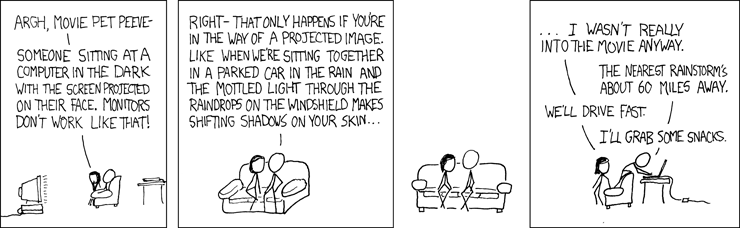
So lately I've been thinking about this comic and why exactly it is true.  In theory, if you are staring at a light source, there should be light bouncing off of your face.  If you have ever taken a magnifying glass to an LCD screen, you should be able to see the clearly defined individual pixels.  The tiny spacing between each pixel should be enough to separate each beam of light and focus it into a projection.  In fact, it really does work.


So why how can both youtube and xkcd be correct?  It's because of the implementation of the light source.  With a direct light source with enough lumens, you can actually push a projection through the LCD which will act as a very sharply focused gel of sorts.  Other than the obvious reason of not wanting to stare into the power of a car's headlight as you work on your homework, the reason xkcd is correct, is because of the use of a reflector.

I order to evenly light the entire screen, and to keep the profile of the monitor as thin as possible, a reflector is used on the back of the monitor.  The light source is actually the same that you might find in a flatbed scanner. It usually lays across the bottom of the monitor and points upwards.  In the back is a diffuse reflector to help evenly smooth the light over the entire surface.

With the indirect angle and low peak candella, LCD monitors are natively poor projectors.

Sunday, August 7, 2011

LCD - Day 7

As I walked across the road to Bruster's tonight, I was being followed.  It was somewhat unnerving the entire time since the black shadow out of the corner of my eye presented an impending sense of possible danger.  Keeping my eyes peeled, I felt that continuing on would be safe.  After all, it was only the beginnings of a thunderhead.

After enjoying my Oreo Blast with chocolate ice cream, the sky gave me one further treat.


I realize that the street light is dead center beyond all else, but look past it.  What beautiful colors!  And it's interesting to think about too.  The sun emits a full spectrum of color in its light, yet as it sets, the angle of incidence on object such as the clouds, changes the reflections and refractions, causing us to perceive different colors in different places.  It's really quite something else.

Saturday, August 6, 2011

LCD - Day 6

I'll spare you the exaggerated anecdotes, and just cut straight to the chase on this post. Normal sarcasm scheduling will resume tomorrow (more than likely).

Tonight I went on an absolutely lovely date with my wonderful fiancé to Walt Disney World. Our main goal was to see some artwork at the Polynesian Resort and then mosey on over to the Grand Floridan to watch "Wishes" from the boardwalk. Due to inclement weather, we decided to skip out on the fireworks and save those for a later blog post, er, I mean, date (in both meanings).

While en promenade, we stopped in the main atrium to admire the big band that was playing nearby when something caught my eye. I noticed that the entire band was extremely well lit, especially for being under an overhang. Plus, the had very soft shadows on their right side.


Since you obviously can't really tell by that photo, here is an underexposed version that'll really make that beauty shine...


Come on, give me some slack. I'm shooting off of a cell phone, you know...

So the darker photo more clearly shows the beam width and edge. After going down a level to look up at the ceiling, I saw this...


Not helpful, I realize.

From another angle, I could see part of the nose of the fixture which hinted at being a Leko of sorts. There was no diffusion gel and the throw distance was definitely too far for a wash light to be effective, so the fixture was extremely out of focus to create a very smooth, soft edge. While I couldn't walk into the center of the band and look for the black dot to confirm an ERS, I am still guessing it is a 26 degree ellipsoidal with a very dropped lens.

Friday, August 5, 2011

LCD - Day 5

No matter what hotel you've ever stayed at in your entire life, there will be a smoke detector near, or aimed directly at, your face. And there aren't enough pillows or blankets in the world to hide you from it. And it blinks...


blinks...


blinks...


blinks...


And you can't help yourself from waking from the most intense and deep sleep of your life just to see it


blink...


blink...


Because you have to count the delay and ponder why on Earth a smoke detector manufacturer chose Pi to the cubic root of seventeen as the delay time. The interesting thing is that there are two extremities to this annoyance. The first is too slow of a delay. After a flash, you forget about it, get over it, and start to fall asleep. By the time you are just about to touch Level One, it flashes again and the process starts from square one.

The other extremity is when a light flashes too fast and there is barely any delay in between assaults. For example, the power light on my desktop PC. My desk is situated in the opposite corner of my room with the tower facing towards the head of my bed. To conserve energy, I put it into standby mode. If any of you have an Acer Aspire E300 series, you can attest to the agitating pattern of the power LED when it's sleeping. Which, if you ask me, the computer isn't really "sleeping". I'd classify it more as silent turret's. So instead of a nicely paced, calm blink every now and then, it's more like

onoffonoffonoffonoffonoffonoffonoffonoffonoffonoffonoffonoffonoffonoffonoffonoffonoffonoffonoffonoffonoffonoffonoff

And did I mention that the LED is BLUE?! In case you are not aware, blue LED's are the most aggravating, bothersome, irritating, troublesome, and vexatious lights in the entire existence of technology; and it's in my face. All night. Flashing rapidly. I swear, a lighting strike inside my bedroom would be more pleasant than the constant onslaught of my PC.


But seriously, who knew that a somewhere-close-to-a-quarter-watt LED could be bright enough to light an entire room?


P.S. Oh, yeah, I know I could just turn my computer OFF, but it's just easier to throw a black hoodie over the front cover.

Thursday, August 4, 2011

LCD - Day 4

I realize most of these observations that I'm sharing are all of happenings that took place while I have been driving. Especially at night. But then, what do you expect to find when driving at night in the city?

Last night, for the first time in my life, I witnessed a UFO!!!

As I was heading to lab, traveling down Forsyth, I looked up in the sky and saw a white flashing disc of light. Underneath, I saw a cone of purple light, if only for a few seconds. I would have stopped to take a picture and prove to you all that they exist, but I was alone and driving. How convenient. But I swear, it was the weirdest phenomenon that I have ever witnessed. They are real! Honest!

Wednesday, August 3, 2011

LCD - Day 3

Last night, my wonderful fiancé landed at MCO. Being the wonderful man she fell in love with, I trudged my down state route 436 to pick her up. On our way back, I discovered the subject of this post.

Florida drivers are nuts. It's absolute insanity that they drive around AT NIGHT with NO HEADLIGHTS. I mean, since it is the city, the roads are pretty well lit, but guess what? No one else can see you! However, it's even more annoying when people drive in the opposite side (heading toward you), in the city mind you, with their high beams [aka, "brights"] on.

Normal headlights aren't necessarily awful unless you are driving a Corvette that practically scrapes the road in which case every headlight is directly at eye-level. Usually, headlights have a pretty concentrated hotspot aiming directly in front of the vehicle and angled down towards the road. I assume this is because of the curvature of the reflector. But if you bear the pain for about two seconds, you'll pass by the hotspot and be able to focus back on the black void in front of you safely.

High beams are different though. There is no escaping the pain. It always appears that no matter how far away, or how far off-axis you are, you just can't see past them. I assume this is, again, because of the curvature of the reflector (not to mention the obvious difference in intensity) to try and throw the light farther and wider down the road.

Well anyway, I was more than annoyed, not to mention distracted. Fortunately, I was the leader of the three-lane caravan traveling down Semoran and didn't have to worry about nearly rear-ending anyone.

In conclusion, high-beams are really annoying. If you find yourself faced with them...


DON'T GO TOWARDS THE LIGHT!

Tuesday, August 2, 2011

LCD - Day 2

I'm going to let you in on a little secret. It is really really sunny in Florida. You literally have no idea. I'm used to that Northern Sun where you can squint or close one eye and still be able to hap-hazardously navigate your vehicle down the freeway. Florida is different. You walk out of Starbucks, and INSTANT BLINDNESS! But it doesn't go away. It's almost like I'm experiencing the sun for the first time. Yeah, the intensity might be greater since I am closer to the equator, but the way the light just purely engulfs things is quite remarkable.

As an Ohioan, I'm used to cloudy and overcast days. It's not really ever a surprise to see the streetlights on in the middle of the day. It just gets dark when the sky gets depressed. But as I eluded to in yesterday's post, the sun can still get to you even with cloud cover in Florida.

So the real observation (since that's what I'm being graded on) concerning this comparison is how you deal with blinding rays of Zeus. In Ohio, it doesn't matter the day; you put your sun visor down and presto! it creates a comfortable reprieve for your eyeballs by casting a soft shadow. In Florida, the physics of diffraction scoff at you as the light seemingly does not distribute regards, bends around your visor, and continues to bombard your retinas. Soft shadow or hard shadow? None whatsoever.

Monday, August 1, 2011

LCD - Day 1

So here we go. First post as a Full Sail student in the second half of my degree program - that being Show Production. In case anyone found this via a Google search, or you are really obsessed with reading any of my stuff, or you are just a creepy stalker; here's some background information about the existence of this blog: Now that I am in Show Production classes, it is an assignment to post daily observations of what I'm studying here. So for the next 28 days, I am putting my observations of light.

And now, the real content...

As I'm sitting here on break during the first day of my Lighting Concepts and Design class, the power went out due to a thunderstorm outside. It wasn't really a big deal since we didn't have the lights on anyway, but it was an inconvenience since you can't teach with a powerpoint when there is no power to the projector. It came back on in time anyway, but I'm still looking out the window at the sky.

Firstly, lighting is freaky but still really freaking cool. A sudden blast of pure white light. I've seen a lot of metal hallide in my days, but nothing compares to its brilliance.

I would go on with my observations about other aspects of the sky, but I will save those for a... well, for another rainy day.